

Being able to create an email without a phone number is key to preserving your privacy.
However, most email services in 2026 require phone verification to complete your sign-up.
That is why we made this guide for you! Together, we are going to explore:
- why anonymity in 2026 is crucial;
- the difference between privacy and anonymity;
- how to create your first anonymous email account.
So let’s get started!
Key Takeaways
- You can create an email account without a phone number – Mailfence does not require one at sign-up.
- Provide an alternate email so you can recover access if you lose your password.
- Use a VPN, two-factor authentication, and aliases to harden the account after signup.
- Privacy ≠ anonymity. Encryption hides what you say; anonymity hides who is saying it. You usually want both.
- Avoid personal details in the account name and recovery fields if full anonymity matters to you.
Why Anonymity is Important
Let’s get one thing out of the way immediately: why do people need an email without a phone number?
The answer is simple: to preserve their anonymity.
Many popular email services such as Gmail ask for your phone number when you sign up. Allegedly, this is to avoid bad actors from using their service. However, companies like Google have made it their business model to collect your data and monetise it.
Choosing to create an email account without submitting your phone number is one way to preserve your anonymity.
What is anonymity?
So, what is anonymity exactly? In a nutshell, anonymity is about hiding your identity. Online anonymity specifically allows you to use the internet without revealing your personal identity or sensitive information. But why is it important? Well, if you’ve made your way to this article, you probably already have a good idea.
By giving away your phone number, you are revealing sensitive information about yourself. Hereßs what can happen:
- Spam and SMS phishing: your number can be sold or leaked to spam lists.
- Cross-referencing with past breaches: a phone number is often enough to link an account to your real name, physical address, and other email accounts.
- Account-recovery exploits: attackers who control your number via SIM-swap can sometimes reset email logins protected only by SMS.
- Subpoena and disclosure risk: a number tied to your real identity makes it easier to compel the provider to identify you.
Anonymity is also vital for those who wish to protect their freedom of speech.
In regions where expressing certain opinions or participating in sensitive discussions can be dangerous, using an anonymous email is essential for personal safety. Whistleblowers, journalists, and activists often rely on anonymous communication to share information securely. Even in less risky situations, such as sharing opinions on controversial subjects, maintaining anonymity helps protect you from potential backlash.
Obviously, you will never be able to stay 100% anonymous online. Signing up for government services, opening a bank account… These will require you to provide your phone number. But there is no reason why an email provider should need your phone number.
Privacy vs. Anonymity: What’s the Difference?
Many confuse privacy with anonymity. While the two concepts are closely related, they do have distinct meanings.
As we touched on in the previous section, anonymity is about hiding your identity. This could be to protect yourself from surveillance capitalism. Or it could be to protect your physical safety in a country without a strong rule of law. Basically, anonymity involves separating your identity from your activities.
Privacy, on the other hand, is about keeping your personal details and actions hidden from certain individuals or organizations.
In other words, privacy doesn’t go as far as full anonymity. For instance, when you send an encrypted email, your message is kept confidential—only the intended recipient can view it. Even if someone intercepts the email, encryption makes it impossible for them to understand the content.
However, privacy doesn’t necessarily mean anonymity. Even if the content of your communication is protected, your identity may still be revealed. Name, IP address… While the details of your communication are protected, the fact that you’re involved in that communication might still be visible to others, such as service providers, governments, or advertisers.
Consider this analogy. Imagine sending a letter through the mail.
Privacy is like sealing the letter in an envelope, ensuring only the recipient can read its content. Anonymity, on the other hand, is sending that letter without a return address—no one knows who sent it. When you create an email without providing a phone number, you remove the “return address,” making it difficult for anyone to trace it back to you.
In short, privacy and anonymity both play important roles, but they serve different purposes. Privacy protects the content of your communication, while anonymity hides your identity. For true digital security, especially in sensitive matters, both are necessary.
How to Create a Free Email Account Without Phone Number Verification
So, you’re finally ready to create an email account that doesn’t require a phone number. Here’s a step-by-step guide on how to do it:
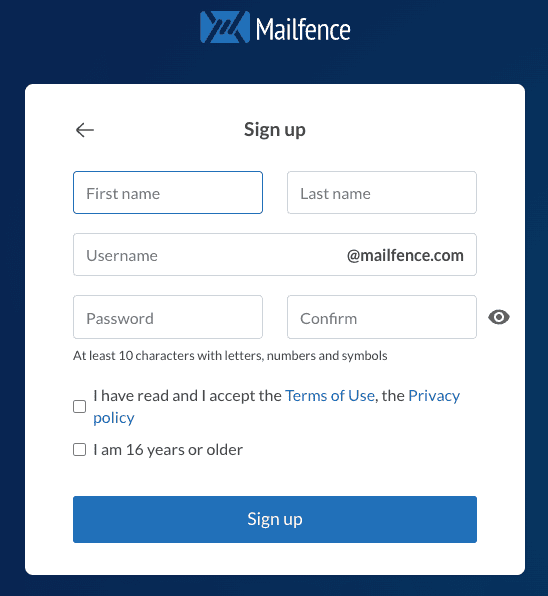
- head over to the Mailfence registration page;
- enter your information and the Mailfence email address you desire. No phone number required 😊;
- we do however require an alternate email – this will let you reset your password in case you ever forget it.
- use a strong password: to safeguard your anonymity and security, create a password that’s difficult to guess, using a mix of characters, numbers, and symbols.
- if total anonymity is important to you, then avoid using personal details. Please note however that if you wish to upgrade to one of our paid plans, a payment method in your name will be necessary.
Boosting Security After Signup
To further secure your anonymity, keep these practices in mind:
- Use a VPN: A Virtual Private Network will obscure your IP address when accessing your email, offering extra anonymity.
- Use Two-Factor Authentication: although this does not improve your online privacy, it will add a layer of security to your account.
- Utilize Aliases: with Mailfence, you can create multiple aliases, making it more difficult to track your online activities.
Which Free Email Providers Require a Phone Number?
Behaviour changes over time and by region. The table below reflects the typical sign-up flow as of 2026. Your results may vary depending on country, IP, or anti-abuse triggers.
| Provider | Phone number required at sign-up? | Notes |
|---|---|---|
| Gmail | Usually yes | Often skippable from mobile/native apps in some regions; desktop browser flows almost always ask. |
| Outlook | Often yes | May accept an alternate email in some regions; will trigger SMS if abuse signals fire. |
| Yahoo Mail | Yes | Phone is a hard requirement in the standard flow. |
| Proton Mail | No | Requires an alternate email for recovery; no phone needed. |
| Mailfence | No | Requires an alternate email for recovery; no phone needed. |
Pros and Cons of Phone Verification
Worth weighing honestly rather than dismissing outright.
Arguments in favour of phone verification (used by mainstream providers):
- Reduces automated bot signups.
- Provides a recovery channel that does not depend on another email account.
- Can flag duplicate accounts at scale.
Arguments against (and why a no-phone option matters):
- Permanently links the account to a real-world identity.
- Creates a single attack surface if your number is SIM-swapped.
- Allows cross-service profiling using the number as a stable identifier.
- Makes accounts compellable under disclosure orders.
For most personal users, a no-phone signup combined with 2FA via an authenticator app gives a better security/anonymity balance than phone verification.
How to Create an Email Without Phone Number: Last Words
That’s it for this guide on how to create an email account without phone number! We hope you found it useful and are now convinced by the value of an email provider that does not require your phone number.
Here at Mailfence, we are committed to:
- No tracking, no advertising. We do not use any third-party advertising or marketing trackers. We do not track your activity in the application. Mailfence is completely free from ads. We do not send spam or solicitations. We will never commercialize our databases or share data with any third party for targeted advertising or any other purpose.
- Strict privacy laws. In many countries, government-sponsored programs collect massive amounts of data from the Internet. This data collection is done without any search warrant, court order, or subpoena. Mailfence’s servers are based in Belgium, with strong laws protecting privacy. Only a valid Belgian court order can force us to release data. Since we have no foreign parent company, we never comply with any rogue or other data requests from either domestic or foreign authorities. We are not liable to US gag orders or NSLs.
- No VC money. Mailfence is 100% self-funded and lives through the subscriptions of our users. No venture capital, no pressure on fast returns. An established company with a spotless 20-year track record.
Want to get started? Create your free Mailfence account today.
FAQ on How to Create an Email Account Without a Phone Number
Why do some email providers require a phone number?
Many providers request phone numbers to verify accounts and reduce spam. However, this compromises your anonymity by linking your account to personal information.
What is the difference between privacy and anonymity?
Privacy protects the content of your communication, while anonymity ensures your identity remains hidden. For example, encryption keeps your messages private, but anonymity hides who sent them
How can I create an email account without providing a phone number?
You can sign up for Mailfence without phone number verification – for free. Simply head to the registration page, use a strong password, and provide an alternate email for password recovery.
How can I recover my Mailfence account if I forget my password?
Through the alternate email you provided at signup. Choose one you control reliably and, ideally, one that is itself not linked to your identity.
How can I enhance my anonymity after creating an account?
Three steps: use a VPN to mask your IP, enable two-factor authentication using an authenticator app rather than SMS, and create aliases so you do not have to share your main address.
Do paid plans require my real name?
A payment method in your name is required for paid plans because payment processors demand it. The free plan does not require this.
What is a National Security Letter (NSL)?
An NSL is a type of administrative subpoena used by U.S. federal authorities to compel disclosure of certain records, typically with a non-disclosure requirement. Because Mailfence has no U.S. presence or U.S. parent company, it is not subject to NSLs.


