

Mailfence is a private and secure email suite built on a simple idea: privacy is a right, not a feature. But Mailfence goes beyond just email. The platform includes a full productivity suite: calendar, documents, contacts, and group collaboration.
This combination is rare. Most email providers focus on security OR productivity. Few do both well. And even fewer let you offer these tools under your own brand. For clients in regulated industries, or anyone handling sensitive information, the ability to offer genuinely encrypted, fully branded email hosted in the European Union is a valuable differentiator.
That’s where private label email hosting comes in. Agencies, MSPs, IT resellers, and professional service firms can take Mailfence’s secure infrastructure and present it to users as their own. The result? A branded, encrypted email and collaboration suite without the cost of building one from scratch.
This post covers how Mailfence’s private label offering works, what it includes, and which organisations benefit most.
Private label, private data: why both matter
Service providers face mounting pressure from users who expect more than basic email. They want encryption. They want collaboration tools. And they want everything under one roof.
At the same time, regulatory requirements are tightening. GDPR, data localisation laws, and industry-specific mandates (such as healthcare, legal, finance) make compliance non-negotiable. But compliance isn’t just about where data is stored; it’s about whose laws apply to it. US providers with European data centres still fall under the CLOUD Act. American authorities can demand access regardless of server location. For users who need genuine EU data sovereignty, “hosted in Europe” isn’t enough. The provider itself needs to be outside US jurisdiction. Ultimately, true data sovereignty requires both an EU-owned data centre and a provider incorporated within the EU – only this combination ensures your data remains exclusively under European law.
Market projections instil context as well as confidence:

Pain points
- Lack of control over client data. Reselling Big Tech email means surrendering client data to a third party – one that might scan emails for ad targeting, warehouse data in privacy-weak jurisdictions, or rewrite terms overnight. You lose control, and your clients bear the risk.
- Compliance uncertainty. Where is client data stored? Who can access it? Can you prove compliance during an audit? These questions haunt providers who rely on opaque platforms.
- The cost of non-compliance: According to the DLA Piper GDPR Fines and Data Breach Survey from January 2025, GDPR enforcement resulted in €1.2 billion in fines across Europe in 2024 alone, bringing total fines since 2018 to €5.88 billion. The Netherlands, Germany, and Poland reported the highest number of data breaches – 33,471, 27,829, and 14,286 respectively.
- Branding inconsistencies. Users log into one interface for email, another for cloud storage, and yet another for calendars. Each looks different. None carries your brand. The experience feels fragmented – because it is.
- Tool sprawl. Piecing together email, file sharing, and scheduling from different vendors creates overhead. It means multiple contracts, multiple support channels, and multiple points of failure.
Private label email hosting solves these problems by consolidating secure email and collaboration into a single, branded platform.
What does Mailfence private label email hosting include?
Mailfence’s white-label offering delivers a full communication and productivity stack. Here’s what’s included.
Full brand customisation
Your users see your brand – not Mailfence. This means your domain name (e.g., mail.yourcompany.com), your logo, and your colour scheme across every tool. The experience feels native to your organisation.
EU-hosted infrastructure
All data lives on servers in Belgium, protected by some of the strongest privacy laws in Europe. Belgian courts require a valid court order to compel data release. There’s no compliance with foreign data requests, no US gag orders, and no NSLs.
Mailfence is fully GDPR-compliant, which matters for any organisation serving European clients – or any business that values data sovereignty.
OpenPGP-based end-to-end encryption
Messages stay private from the moment they’re sent until the recipient decrypts them. Mailfence uses OpenPGP encryption and supports digital signatures, so recipients can verify message authenticity.
Complete collaboration suite
Email alone isn’t enough. Mailfence includes a full set of tools that work together:
| Feature | Function |
| Secure messaging with encryption, plus fax and SMS sending | |
| Calendar | Personal and shared calendars with event scheduling |
| Contacts | Address books you can keep private or share with teams |
| Documents | File storage and management with access controls |
| Groups | Collaboration spaces for teams, projects, or client work |
| Instant messaging | Real-time chat via XMPP protocol |
All of these tools integrate with each other.
How do user profiles work in Mailfence private label?
In Mailfence’s private‑label (white‑label) offering, “user profiles” are fully managed and branded by the organisation, with a few key characteristics:
1. What a “user profile” actually is
- Each user profile is a regular Mailfence account (with email, calendar, contacts, documents, etc.) but:
- Can send and receive from your own domain like user@yourcompany.com, instead of mailfence.com.
- Appears under your brand (custom logo, login page, and sometimes custom domain for the web interface).
- From the end user’s perspective, it looks and feels like your own email service, not Mailfence.
2. How profiles are created and managed
- The organisation (you) accesses the Admin Console.
- From there, you can:
- Create new user accounts (profiles) with your domain.
- Assign them to groups (for shared calendars, documents, etc.).
- Set subscription level (storage, features) and expiration date.
- Add/remove aliases (e.g., support@yourcompany.com → user profile).
- Reset passwords or delegate password management.
- Suspend or delete accounts.
Each profile is tied to a username and password (or SSO, if configured), and behaves like a normal Mailfence account once logged in.
3. Branding and white‑label aspects
In a private‑label setup, Mailfence adapts the user experience to your brand:
- Domain & email addresses: All profiles use your domain(s), not Mailfence’s domains.
- Login page: Customized with your logo (so users see your brand, not Mailfence).
- Web interface: Can be branded so that the webmail, calendar, and docs feel like your own product.
- API & automation: You can create, update, and manage profiles programmatically via Mailfence’s API (for provisioning, billing, etc.).
- LDAP/Active Directory integration: Syncs your corporate directory to automatically provision, update, and deactivate Mailfence user accounts while enabling seamless Single Sign-On (SSO) with existing company credentials—no separate passwords required.
This is what makes it a true “private label” service: the end user doesn’t know they’re using Mailfence unless they look at the underlying infrastructure.
4. What users can control in their profile
Once logged in, each user can manage their own profile settings:
- Display name and avatar (shown as sender name in emails).
- Email addresses: Set primary address and add/remove aliases (within plan limits).
- Security: Enable 2FA, manage OpenPGP keys, set up recovery options.
- Preferences: Layout, signatures, away message (out‑of‑office), filters, etc.
- Privacy: create private groups
However, the admin (you) retains control over:
- Subscription level and features.
- Domain ownership and DNS.
- Institutional Group creation and membership.
- Account suspension/deletion.
4.a. Admin Console
The Admin Console is your central cockpit for managing users, security, and collaboration.
Quick Reference
| Area | What You Can Do |
| User Lifecycle | Create, suspend, delete accounts; manage settings and subscriptions |
| Identity & Addressing | Domains, aliases, forwarding rules |
| Groups & Workspaces | Shared resources, permissions, collaboration settings |
| Security & Recovery | 2FA, audit logs, email restoration |
| Billing & Usage | Credits, storage quotas, traffic reports |
User Lifecycle
- Account actions: Activate, suspend (temporary block), or permanently delete users; bulk import/export
- Settings: Change names, passwords, subscription tier, expiration dates
- Monitoring: View connection history, account status
- Delegation: Assign co-admins (private label) or “customer lite” admins who can provision users within their SME
Identity & Addressing
- Domains: Add/verify custom domains, configure SPF/DKIM, assign domains to users
- Email addresses: Change internal address, notification email
- Aliases: Create, delete, enable/disable per plan
- Mail routing: Set up automatic forwarding or transfer rules
Groups & Workspaces
- Group management: Create institutional groups, assign members
- Permissions: Define read/write access for shared calendars, documents, address books, and shared mailboxes
- Branding: Apply group-level private label settings
- Membership types: Distinguish between “customer lite” (provisioning only) and full workspace membership
Security & Recovery
- Two-factor authentication: Enforce globally or deactivate per user (e.g., lost device)
- Access control: IP restrictions, audit logs
- Email recovery: Restore deleted emails up to 30 days back
Billing & Usage
- Credits: Track provisioned vs. consumed; monitor usage
- Storage: Allocate quotas per plan, view per-user consumption
- Traffic: Mail volume reports to optimize costs
This covers far more than we can explore in a single article – but these tools give you full control over user lifecycle, security posture, and collaboration structure.
5. Technical options (cloud vs. licence)
Depending on the private‑label contract, profiles can run in two ways:
- Cloud (hosted by Mailfence)
- Profiles are hosted on Mailfence’s infrastructure in Belgium.
- Best for smaller deployments (up to a few thousand users).
- You get an SLA and don’t manage servers.
- Licence (self‑hosted)
- You run Mailfence on your own Linux servers.
- Profiles are stored and managed entirely in your infrastructure.
- Typically used for very large organizations (1,000+ users) that want full control.
6. How does pricing work?
One of Mailfence’s strengths is flexibility: instead of forcing everyone onto a single plan, you can assign each user the right plan for their role. In a private-label setup, all users get a branded email address (like user@yourcompany.com) and access to Mailfence’s secure email, calendar, and documents – but you decide which plan each person gets.
This means:
- Admins and power users can have large storage and full features.
- Regular staff get solid email and collaboration at a lower cost.
- Light users or external partners can be on a basic plan for as low as €0.90/month.
Here’s how that looks in practice with two realistic team sizes, and how it compares to a standard Microsoft 365 setup.
Example 1: 100-person team
Imagine a small company or agency with 100 people: the standard Mailfence pricing applies for clarity*:
| Role | Plan | Count | Price per user | Total per month |
| Admins | Ultra | 2 | €29.00 | €58.00 |
| External partners | Starter | 8 | €0.90 | €7.20 |
| Staff | Entry | 30 | €3.50 | €105.00 |
| Regular users | Base | 60 | €2.50 | €150.00 |
| Total | 100 | €320.20 |
With a 15% volume discount for at least 100 users, the total drops to €272.17/month – about €2.72 per user.
Microsoft 365 comparison: The same 100 users on Microsoft 365 Business Basic (~€4.20/user/month) would cost €420/month. Mailfence’s flexible mix is 35% cheaper while offering stronger privacy and EU data residency.
Example 2: 1,000-person organisation
Scale the same approach for a larger organisation or MSP:
| Role | Plan | Count | Price per user | Total per month |
| Admins | Ultra | 5 | €29.00 | €145.00 |
| External partners | Starter | 80 | €0.90 | €72.00 |
| Staff | Entry | 100 | €3.50 | €350.00 |
| Regular users | Base | 815 | €2.50 | €2,037.50 |
| Total | 1,000 | €2,604.50 |
With a 30% volume discount for at least 100 users, the total drops to €1,823.15/month – about €1.82 per user.
Microsoft 365 comparison: 1,000 users on Microsoft 365 Business Basic would cost €4,200/month. Mailfence saves over €2,375/month – or €28,500/year.
*Prices include VAT. Standard Mailfence pricing is used here for simplicity. However, you can reduce costs further through quota-based optimisations, e.g. adjusting storage allocations based on your specific feature requirements.
Which businesses benefit most from Mailfence private label?
Mailfence’s private label email hosting fits organisations that need encrypted communication, collaborative tools, and full control over branding and data.
SMBs and IT service providers
SMBs can stand out by bundling secure email with their existing services. Rather than using Big Tech – and inheriting its compliance baggage – they deliver a privacy-first solution with their own branding.
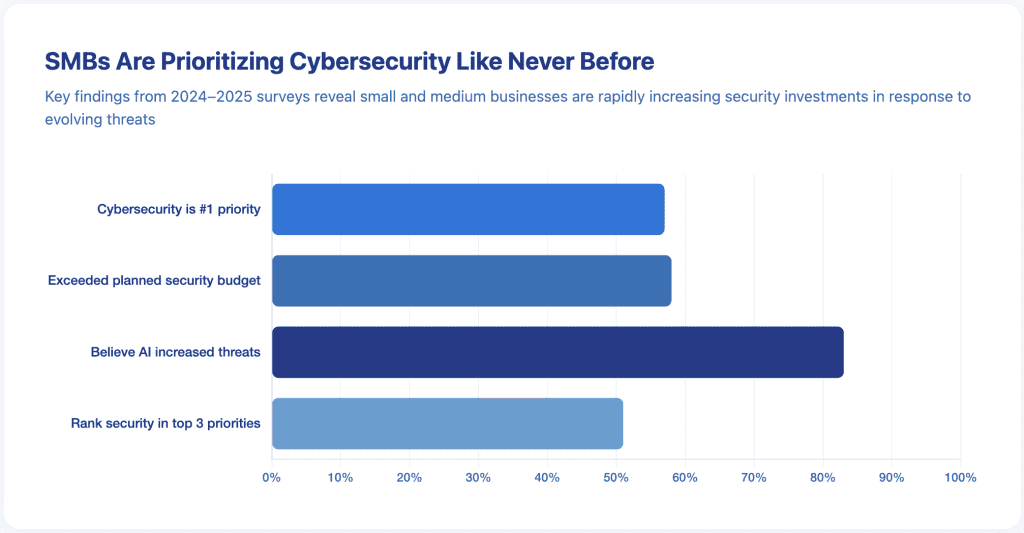
SMB security priorities: 58% of SMBs spent more on cybersecurity in 2024 than originally planned, and 57% now rank cybersecurity as their top business priority – up from 43% the previous year. MSPs who can deliver secure, compliant email solutions are well-positioned to capture this demand.
Legal firms and consultancies
Attorneys handle sensitive information daily. Attorney-client privilege depends on confidentiality. Mailfence’s end-to-end encryption and digital signatures protect communications in transit and verify sender authenticity.
AVOCATS.BE, the organisation representing attorneys in the French and German-speaking parts of Belgium, chose Mailfence for exactly this reason. As Benjamin Jennes, IT Manager for AVOCATS.BE, explains:
“Security is a crucial aspect for lawyers dealing with sensitive information. Thanks to Mailfence’s advanced security protocols, emails are protected against unauthorized access.”
Read the full case study here.
Agencies and professional services
Client-facing businesses benefit from branded tools that reinforce professionalism. When users log in and see your logo, they engage with your brand – not a third-party platform.
Aya Data, an AI consulting company, switched to Mailfence after outgrowing their previous provider’s rigid pricing. Dr. Prince Oberko, Chief Information Officer, says:
“First and foremost, we were seeking an effective and efficient emailing tool with a flexible pricing to manage our costs effectively. We also need a multifaceted system that incorporates various tools: emails, calendars, cloud storage, etc. […] Ultimately, we are extremely pleased with our move to Mailfence.”
Read the full case study here.
NGOs and advocacy groups
Organisations working on sensitive issues – human rights, journalism, political advocacy – face surveillance risks. Mailfence’s encryption and Belgian jurisdiction offer protection against overreach.
Financial services and accountants
Client confidentiality is foundational to financial work. Mailfence helps firms meet regulatory requirements while offering the collaboration tools (shared calendars, document storage, group workspaces) that modern practices need.
RISS, a non-profit in the telecommunications sector, chose Mailfence as a SharePoint alternative for document collaboration.
“Mailfence gives me the capacity to define very precise access rights to documents, based on which Group a user belongs to” – Pascal Veracchia, Business Group Digital Leader.
Read the full case study here.
How do you get started with Mailfence private label?
Getting started with Mailfence private label email hosting is straightforward.
Step 1: Define requirements
Identify what your organisation needs: how many users, which profiles, and what branding elements. Think about whether you need SSO integration or API access for your own systems.
Step 2: Contact Mailfence
Reach out to discuss your requirements. Together, we’ll create custom solutions based on your actual needs – not a one-size-fits-all plan.
Step 3: Configuration and customisation
Mailfence configures your private label instance with your domain, logo, and user profiles. Implementation typically takes about three weeks:
- Week 1: Information collection via questionnaire
- Week 2: Preparation of a test version
- Week 3: Release of your personalised version (including any migrations)
Step 4: Admin panel access
Once live, you have full control over your instance through the admin panel. Create accounts, manage subscriptions, rename email addresses, and adjust settings without waiting on vendor support.
Step 5: Ongoing support
Mailfence handles maintenance, updates, and infrastructure. Your team focuses on serving clients while Mailfence keeps the platform running.
Key takeaways: Private label email hosting with Mailfence
1. Private label email hosting lets you offer secure, branded email and collaboration tools without building infrastructure
2. Mailfence combines OpenPGP encryption with a full productivity suite (email, calendar, documents, tasks, polls, instant messaging)
3. Mailfence offers lexible user profiles – pay for what you need
4. EU hosting in Belgium means GDPR compliance and strong data sovereignty
5. Full customisation: your domain, logo, colours, and user profiles – your clients see your brand
5. Admin panel and API give you autonomy to manage accounts without vendor dependency
Final thoughts on private label email hosting with Mailfence
Private label email hosting addresses a real gap in the market. Clients want secure communication and modern collaboration tools. They want everything under one brand. And they want the confidence that their data is protected by strong privacy laws.
Mailfence delivers all of this. Encrypted email, calendar, documents, tasks, polls, and instant messaging – fully branded and hosted in the EU. No ads, no tracking, and no compromises on privacy.
The flexible pricing model makes it practical for organisations of any size. You’re not locked into paying enterprise rates for users who only need basic access. And you’re not sacrificing features for users who need the full suite.
If you’re an MSP, agency, legal firm, or any organisation looking to offer more than basic email, Mailfence’s private label solution is worth exploring. You get the infrastructure without the overhead – and your users get a professional, secure experience under your name.
If you want to hear more privacy-related content, give our monthly newsletter a follow!
FAQ about private label email hosting
What is private label email hosting?
Private label email hosting lets you offer email services under your own brand using another provider's infrastructure. You get a fully functional email platform (with your domain, logo, and styling) without building or maintaining the technology yourself.
With Mailfence, this extends beyond email to include a complete collaboration suite – calendar, documents, tasks, polls, and instant messaging. Your clients access secure tools branded as your own service.
How is private label email different from email reselling?
Reselling typically means you're selling access to someone else's product. Clients know they're using that provider. Private label hosting, by contrast, puts your brand front and centre. Clients see your domain, your logo, and your interface.
Mailfence's private label solution gives you the branding control of a proprietary platform without the development costs.
Is Mailfence private label email hosting GDPR compliant?
Yes. Mailfence hosts all data in Belgium under strict European privacy laws. The platform is fully GDPR compliant, which matters for any organisation serving European clients or handling personal data.
Because Mailfence has no US parent company, it isn't subject to US data requests, gag orders, or National Security Letters.
How much does Mailfence private label cost?
Mailfence private label pricing starts at €0.90 per user per month, with volume discounts up to 30% for larger teams. Unlike fixed per-seat pricing, Mailfence lets you mix plans across your organisation – so you only pay for what each user actually needs. Setup costs are marginal and include configuration, branding customisation, and potential migration.
Flexible pricing by role
Every user gets a branded email address (user@yourcompany.com) plus access to secure email, calendar, and documents. You choose which plan fits each person:
- Starter (€0.90/month) – for external partners or light users
- Base (€2.50/month) – for everyday users
- Entry (€3.50/month) – for staff needing more storage and features
- Ultra (€29.00/month) – for admins and power users with maximum storage
Real-world cost examples
A 100-person team mixing these plans typically pays around €272/month after the 15% volume discount – about €2.72 per user. That's 35% less than Microsoft 365 Business Basic for the same headcount.
At 1,000 users, the 30% volume discount brings the average cost down to roughly €1.82 per user per month, saving over €28,500 annually compared to Microsoft 365.
Can I integrate Mailfence with my existing authentication system?
Yes. Mailfence integrates with external authentication and SSO providers. This makes access easier for users and simpler to manage for IT teams. The API also lets you build account management into your own systems.